
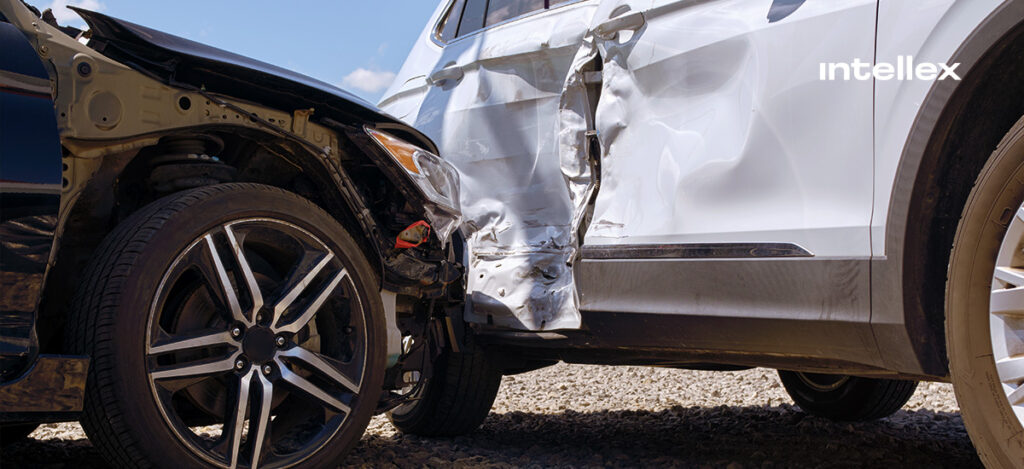
Event data recorders (EDRs), also known as black boxes, play a vital role in accident reconstruction and crash analysis. Using the proper extraction methods and EDR crash data analysis methodology is crucial for delivering strong, admissible evidence in court. Qualified accident reconstruction experts have the skills, knowledge and experience to analyze EDR data points and provide defensible testimony.
What Does Accident Reconstruction EDR Evidence Capture?
An EDR is a module that monitors a vehicle’s physics, capturing accident reconstruction vehicle data. This device is embedded into the vehicle’s airbag control module (ACM), and it determines if safety restraints should deploy.
The Code of Federal Regulations sets the baseline for what an EDR must record in the 49 CFR Part 563 Standard. This federal regulation requires all vehicles equipped with an EDR and manufactured on or after September 1, 2012, to capture a standardized set of data elements. Under this standard, accident reconstruction experts can reliably expect to find the following data points critical to liability determination:
- Vehicle speed: A vehicle’s EDR records speed in 0.5-second intervals leading up to a crash.
- Engine revolutions per minute (RPM): Engine RPM can help professionals determine if a vehicle was accelerating or coasting at the time of an accident.
- Brake status: The EDR typically records a vehicle’s brake status as “on” or “off.” However, many systems now record the percentage of a brake pedal’s application, providing a more precise analysis of how a driver used the brake.
- Accelerator pedal position: Measuring the accelerator pedal position helps determine driver intent. For example, the driver may have been flooring the gas at the time of a collision.
- Change in velocity (Delta-V): Delta-V determines the cumulative change in speed during a crash pulse, which is a primary metric for crash severity.
- Safety belt status: Safety belt status confirms whether the driver and front passenger were wearing seat belts at the time of impact.
While 49 CFR Part 563 sets the minimum mandate for EDRs, many manufacturers set vehicles to exceed these requirements. For example, certain vehicles may record data points such as vehicle rotation rate, steering wheel angle and roll rate.
How Is EDR Evidence Used?
Accident reconstruction experts use EDR data to achieve the following:
- Refute or confirm speeding allegations
- Prove that a driver reacted to and tried to avoid a collision
- Analyze airbag deployment and seat belt use in serious injury cases
- Reconstruct accidents involving multiple vehicles to evaluate chain reactions
- Test competing claims about a collision’s cause
Types of EDR Data
Forensic analysis distinguishes between the following two types of data stored in an EDR:
Precrash Data
Precrash data serves as a rolling buffer, capturing the 5 to 20 seconds of driver inputs before the algorithm activates or an impact occurs. Forensic engineers use precrash inputs as “behavioral” data. It reveals details such as driver distraction, aggression and reactions. For example, it may indicate that a driver applied full throttle application or demonstrated no steering or braking input until the final moment before impact.
An EDR constantly overwrites precrash data until a deployment event occurs. Immediate preservation is vital if a case calls for precrash data.
Crash Pulse Data
Crash pulse data records the physics of an impact. It captures the longitudinal and lateral forces experienced by a vehicle. This input is vital for biomechanical engineers to determine if the vehicle’s forces on impact were sufficient to cause the specific injuries a plaintiff claims.
Airbag Deployment and Nondeployment Events
A common misconception is that black box data is only available if airbags deploy. This is false and can cause legal teams to overlook critical evidence in cases with minor to moderate impact.
Manufacturers design EDRs to activate and assess crash severity even when an impact does not trigger airbag deployment. The EDR records this as a “nondeployment” event. The system may lock a nondeployment file if a vehicle experiences a sudden change in velocity or hits a pothole hard enough to trigger the EDR’s algorithm.
A nondeployment file contains the same precrash speed and braking data as a deployment event, but subsequent driving cycles can overwrite it. In cases involving low-speed impacts or soft-tissue injuries, it’s crucial to secure the vehicle immediately. Quick action prevents legal teams from losing the EDR’s data on the incident forever.
EDR System Limitations
Assessing system limitations helps manage client expectations. EDRs in older vehicles may not capture vehicle speed or may only capture it in larger intervals, which can miss rapid braking maneuvers. A standard EDR may also lack details such as a vehicle’s specific driver, time of day and GPS location at the time of impact, unless it features advanced telematics modules. Standard EDRs provide a record of the vehicle’s physics, not the driver’s actions inside the cabin.
Proper EDR Data Extraction and Preservation
The methodology a team uses to extract EDR data is just as important as the data itself. If an untrained technician activates a vehicle incorrectly or uses the wrong interface, they could potentially alter the data, overwrite nondeployment events or corrupt the file. This constitutes spoliation of evidence, which can lead to adverse inference instructions or a court excluding the defense’s entire reconstruction.
Direct-to-Module vs. OBD-II Port Data Extraction
OBD-II port download and direct-to-module extraction are the two primary EDR data extraction methods. The ideal method depends on the condition of the vehicle’s electrical system.
- OBD-II port download: OBD-II port download is the most effective extraction method for an undamaged vehicle. The analyst connects the crash data retrieval (CDR) tool or manufacturer-specific tool to the diagnostic port under the vehicle’s dashboard.
- Direct-to-module extraction: A direct-to-module extraction is necessary in cases of severe vehicle damage. With this method, the accident reconstructionist removes the ACM from the vehicle and connects it to the retrieval computer with a specialized direct-to-module cable.
OBD-II is the least invasive option, but it requires the vehicle’s electrical system to be fully intact. Attempting to jump-start a vehicle with a destroyed battery or severed wiring harness can cause power surges that may corrupt the EDR module. If the vehicle’s electrical system is compromised in any way, the more invasive direct-to-module extraction method is the only way to bypass the vehicle’s damaged wiring and retrieve data.
Forensic Image Protocol
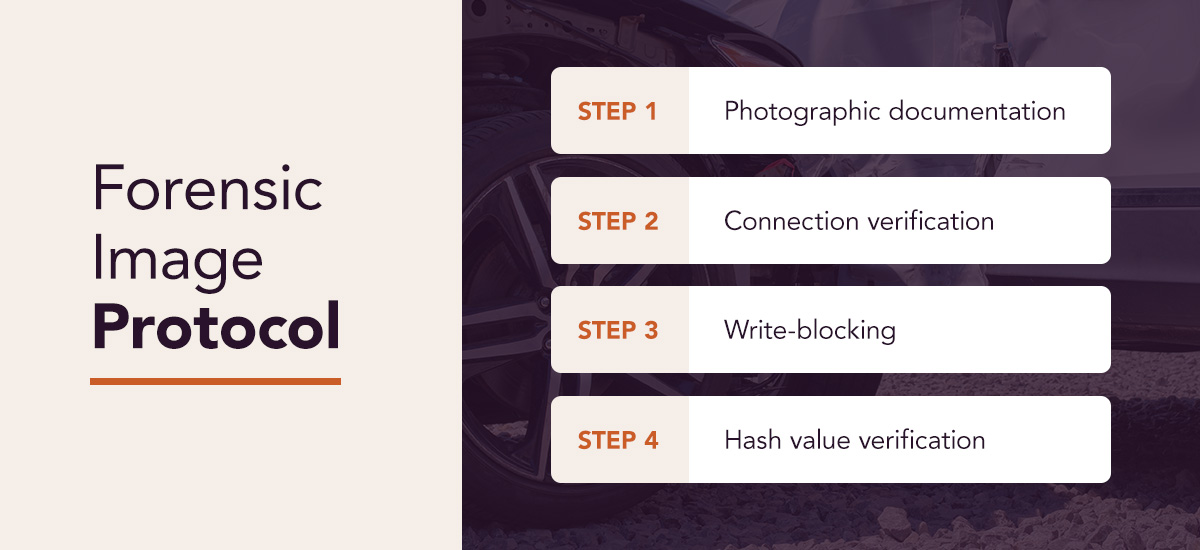
Documenting the extraction process step-by-step helps legal teams prevent spoliation. A professional engineer (PE) or certified analyst must create a forensic image of the setup before touching a single wire. This protocol takes place in the following steps:
- Photographic documentation: First, an analyst must verify that the vehicle’s VIN displayed on the dashboard matches the electronic VIN and the VIN on the door jamb.
- Connection verification: Next, the analyst photographs the cable connections to prove that they used the correct adapter to extract the data.
- Write-blocking: It’s also vital to ensure the retrieval tool is in “read-only” mode so no data can be written back to the vehicle during download.
- Hash value verification: When an analyst saves a file, the software generates a hexadecimal code or hash value. This digital fingerprint ensures that no one has altered the file since the moment of download. Any discrepancy in the hash value during discovery suggests tampering.
To ensure the software generates a verifiable hash value during extraction, analysts use specialized forensic software and a hardware write-blocker to produce an exact, bit-for-bit forensic image or copy of the original media.
Chain of Custody
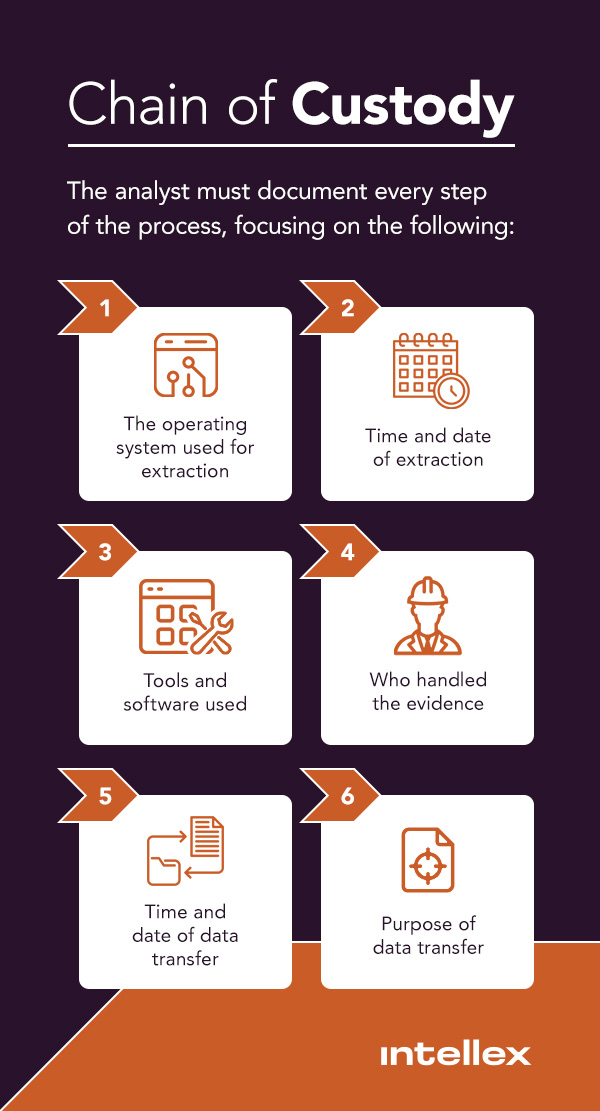
Maintaining a meticulous chain of custody is crucial for preventing spoliation. The analyst must document every step of the process, focusing on the following details:
- The operating system used for extraction
- Time and date of extraction
- Tools and software used
- Who handled the evidence
- Time and date of data transfer
- Purpose of data transfer
Each custodian must sign off on transfers. It’s also essential to store the forensic image and original evidence safely on encrypted drives and secure servers, restricting access to protect data.
Power Failure Protocols
Total power loss is common in severe collisions. If a battery is destroyed or ejected early in a crash sequence, the vehicle’s EDR relies on internal capacitors to finish writing the crash record. In some cases, the write process can be interrupted.
It’s important to work with experts who use specialized auxiliary power units. These units supply a clean, regulated 12-volt current to the module to activate it safely on the bench. This process enables legal teams to retrieve interrupted or partial files, which are often the most revealing because they come from the most severe crashes.
Extraction Technology Selection
Not all EDR boxes and the tools analysts use to read them are the same. One tool may cover several vehicle makes and models, but not all of them. For example, several Hyundai and Kia models require separate tools, and Subaru and Mitsubishi models tend to have specific legacy requirements.
Using a generic OBD-II scanner or the wrong CDR software version can cause a hex dump, which is a string of unintelligible and potentially incomplete raw code. Professional reconstructionists maintain active subscriptions to all major manufacturer software suites to ensure they parse data with the latest OEM’s data dictionary.
Vehicle Event Data Recorder Interpretation and Integration With Physical Evidence
A raw EDR report is not a conclusion — it’s a set of data points that require expert interpretation. Raw data in the hands of an unqualified interpreter can be dangerous, so it’s important to work with an expert who understands the following factors:

The “Garbage In, Garbage Out” Risk
Data can be misleading without expert contextual interpretation. EDR sensors measure wheel rotation to calculate speed. If a vehicle slides on black ice or hydroplanes, the wheels may spin slower than the vehicle actually travels. Alternatively, a vehicle’s wheels may spin rapidly if it becomes airborne, registering a faster speed than the vehicle actually travels.
For example, consider an EDR records a precrash speed of 85 miles per hour (mph). An inexperienced analyst may take this at face value. An experienced analyst considers additional data points such as the engine RPM and throttle percentage. If a throttle was at 0%, but the speed increased, and the stability control flag was active at the time of collision, it suggests that the wheels lost traction or the vehicle was in a yaw. This evaluation invalidates the speed reading.
Correlating Delta-V With Crush Damage
Correlating digital Delta-V with physical crush damage is one of the most powerful validation techniques that forensic and accident reconstruction engineers use to analyze data. Delta-V represents a vehicle’s change in velocity during impact.
For example, if an EDR records that a vehicle experienced a 25 mph Delta-V, the vehicle must show a corresponding amount of structural deformation. Engineers use energy-crush algorithms to calculate how much force is required to crush a frame rail or fender by a specific depth. These algorithms are based on stiffness and coefficients from crash tests.
If a physical reconstruction calculates a Delta-V of 25 mph, and the black box reports 24.5 mph, the evidence is mutually reinforcing. This cross-validation helps create a reliable and nearly unshakeable expert testimony. Any major discrepancies, such as a vehicle with a minor scratch and a black box report of 40 mph Delta-V, alert the expert to investigate a potential data mapping error or sensor malfunction.
Verifying Speed vs. Distance
Another critical cross-check involves the physics of stopping distance. A vehicle’s EDR provides the vehicle’s speed and brake status for several seconds before impact. By integrating this speed data over time, an expert can calculate precisely how far the vehicle traveled during the precrash window.
The expert can then compare the calculated distance to the physical evidence at the scene, such as the start of skid marks or the point of rest. For example, there should be corresponding tire marks on the road if an EDR reveals a driver braking hard for two seconds. If the marks are absent, the expert analyst should look into a potential offset data time-sync or an antilock braking system (ABS) engagement that prevents skidding.
Driver Behavior Analysis
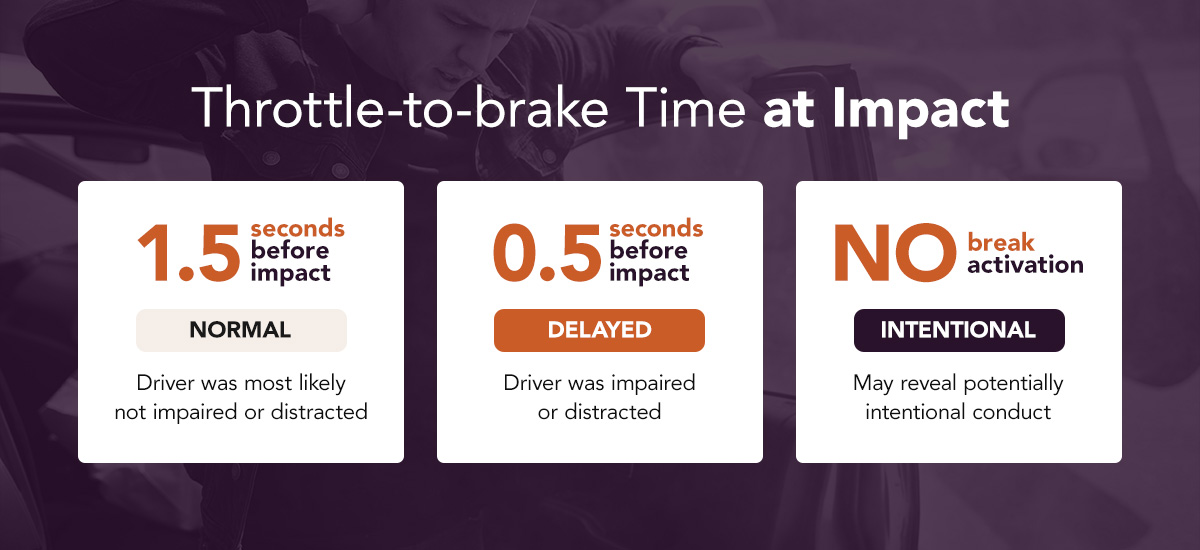
Beyond the physics, EDR data enables experts to reconstruct a driver’s cognitive state. An expert analyst can evaluate the time between throttle release and brake application to calculate reaction time. The following types of reactions indicate various details about a driver’s cognitive state in an accident:
- Normal reaction time: A normal perception or reaction time is typically 1.5 seconds. A reaction time near this number indicates that the driver was most likely not impaired or distracted at the time of impact.
- Delayed reaction: If EDR data reveals that a driver didn’t lift off the gas until 0.5 seconds before impact, despite a clear line of sight, an expert can conclude that the driver was impaired or distracted.
- Intentional act: A full throttle with no brake activation right up to the moment of impact may reveal potentially intentional conduct.
Experts use narrative building to turn data points into a timeline of human decision-making. This ability is the most valuable analysis experts can provide to litigation teams.
Admissibility Challenges
Even the most incriminating data is useless if the court excludes it from trial. The admissibility of EDR evidence typically hinges on the Daubert standard in federal courts and many states or the Frye standard in states such as New York and California.
Establishing Reliability
Under Daubert, a judge acts as a gatekeeper to ensure scientific evidence is reliable. EDR data is typically admissible in court under the Daubert and Frye standards because courts consider black boxes reliable technology. However, car black box data admissibility hinges on experts providing the following details and evidence:
- The raw numbers collected from the EDR
- Proof of proper data collection
- Proof of the data’s accuracy
- Interpretation using established engineering principles
Expert Qualification Standards
A frequent challenge or point of attack in cross-examination is the qualification of the individual analyzing and presenting the data. A technician who has taken a brief certification course may be able to authenticate a download effectively, but they are often unqualified to interpret the data.
The court may sustain objections when a technician without an engineering background attempts to testify about Delta-V or driver behavior patterns, making retaining a PE or Accreditation Commission for Traffic Accident Reconstruction (ACTAR)-accredited reconstructionist is critical. Qualified experts can testify to the underlying physics of EDR data, reliably bridging the gap between software reports and the reality of collisions.
Addressing “The Black Box Is Wrong” Defenses
A common defense tactic is to claim that a sensor was faulty at the time of impact or that data was corrupted upon collection. To rebut this, experts look for saturation or clipping in the data. If a sensor records a maximum value and the graph flatlines at that peak, the expert acknowledges the limitation. For example, they may explain that a crash is at least as severe as a sensor’s capacity if a force exceeds it.
Experts also validate data integrity by checking a vehicle’s ignition cycle count at the time of a crash against its current odometer reading. If the crash record indicates the crash occurred at ignition cycle 5,000, and the vehicle currently reads 5,002, the data is inextricably linked to the subject event.
Jurisdictional Nuances
While most jurisdictions accept EDR data, it’s crucial to lay the foundation correctly. In some states, the expert analyst must explicitly testify that the specific tool they used was the current, validated version at the time of download and analysis. Failure to update the software can lead to data parsing errors, and opposing counsel can use this to cast doubt on the report.
Privacy Considerations and Legal Access Requirements
Legal access is another challenge. Legal teams must obtain the necessary rights to collect EDR data before they can utilize it.
The “Data Ownership” Doctrine
The general legal consensus, codified in the Driver Privacy Act of 2015, is that the data stored in the EDR belongs to the vehicle’s owner or lessee, not the manufacturer or insurance company. This doctrine means that law enforcement cannot download a black box at the scene without a warrant or the vehicle owner’s consent. Similarly, a defense expert cannot inspect a plaintiff’s vehicle and download the data during a general inspection without explicit permission.

Securing Access for Civil Litigation
Law enforcement and legal teams typically secure access to EDR data for civil litigation through the following three mechanisms:
- Consent form: The simplest method of securing access is to ask the vehicle owner to sign a “Consent to Inspect and Download” form.
- Preservation letter: Immediately following a collision, counsel should send a preservation letter requesting that the vehicle and its EDR data be preserved unchanged. This letter notifies the opposing party that spoliation sanctions apply if they subsequently drive the car or crush it.
- Court order: If the opposing party refuses to provide the vehicle and EDR data, a motion to compel inspection is necessary. The argument is for the motion is based on the objective, nonreplicable nature of the EDR evidence.
Discovery Implications
Specificity is vital when requesting EDR data in discovery. In addition to a Bosch report printout, counsel should request the native digital file in a .CDR or .ACM extension. A PDF file is a static interpretation of the data using a specific software version. If the software is later updated to fix a bug in how it calculates speed, the PDF remains wrong.
Possessing the native file allows the expert analyst to reopen the data in the latest software version to ensure the most accurate interpretation. Furthermore, the native file contains the hex data and metadata required to verify authenticity.
Trust Intellex for Expert EDR Data Extraction and Analysis
In the modern accident reconstruction landscape, EDR data provides the hard numbers for subjective testimony. Since the EDR is a complex piece of digital evidence, expert interpretation is crucial.
Intellex offers expert EDR extraction, analysis and testimony. Our team of accident reconstruction experts features ACTAR-accredited professionals and certified Bosch CDR Data Analysts who understand the science behind sensors and courtroom strategy. Rather than simply handing you a report, we validate the data against physical evidence to provide a unified, defensible theory of the case. Request an expert to retain a certified Accident Reconstructionist for your EDR data extraction and analysis needs,